
Types of Web Hosting: Shared, VPS, Cloud, Dedicated & Managed
This guide may contain affiliate links. If you buy through them we may earn a commission at no extra cost to you. As an Amazon Associate I earn from qualifying purchases. Learn more.
Lessons 2 of 10
Quick Overview: The main types of web hosting are shared, VPS, cloud, dedicated and managed WordPress hosting. They differ in price, power, control and how much technical work you do yourself. This lesson compares the types of web hosting side by side and shows which one fits your site today.
To put it simply, think of hosting like housing. Shared hosting is a room in a busy apartment, a VPS is your own apartment, cloud hosting is a flexible flat that grows with you, and a dedicated server is a whole house. Managed hosting, on the other hand, is like having a caretaker who handles repairs for you.
Types of web hosting compared
| Type | Cost | Power | Skill needed | Best for |
|---|---|---|---|---|
| Shared | Lowest | Basic | None | New blogs, small business sites |
| Managed WordPress | Low to medium | Good | None | WordPress sites that want speed and care |
| VPS | Medium | High | Some | Growing sites, custom setups |
| Cloud | Medium to high | High, scalable | Some | Traffic spikes, online stores |
| Dedicated | Highest | Maximum | Advanced | Large sites and apps |
Shared hosting
First, with shared hosting, many websites share one server’s memory and processor. As a result, it is the cheapest option and needs no technical skills, because the host manages the server. However, the downside is that a very busy neighbor can slow your site a little. For most new sites, however, shared hosting is the right start.
Managed WordPress hosting
In contrast, managed hosting means the provider takes care of technical tasks such as updates, backups, security and caching. In particular, managed WordPress plans are tuned for WordPress specifically. Therefore, they suit people who want to focus on content, not servers. Hostinger, for example, offers WordPress plans with automatic setup and updates.
VPS, cloud and dedicated hosting
- VPS hosting gives you a private slice of a server with guaranteed resources. For details, see What Is VPS Hosting?
- Cloud hosting spreads your site over several servers, so it can grow during traffic spikes. Learn more in What Is Cloud Hosting?
- Dedicated hosting gives you an entire physical server. Our guide What Is Dedicated Hosting? explains it.
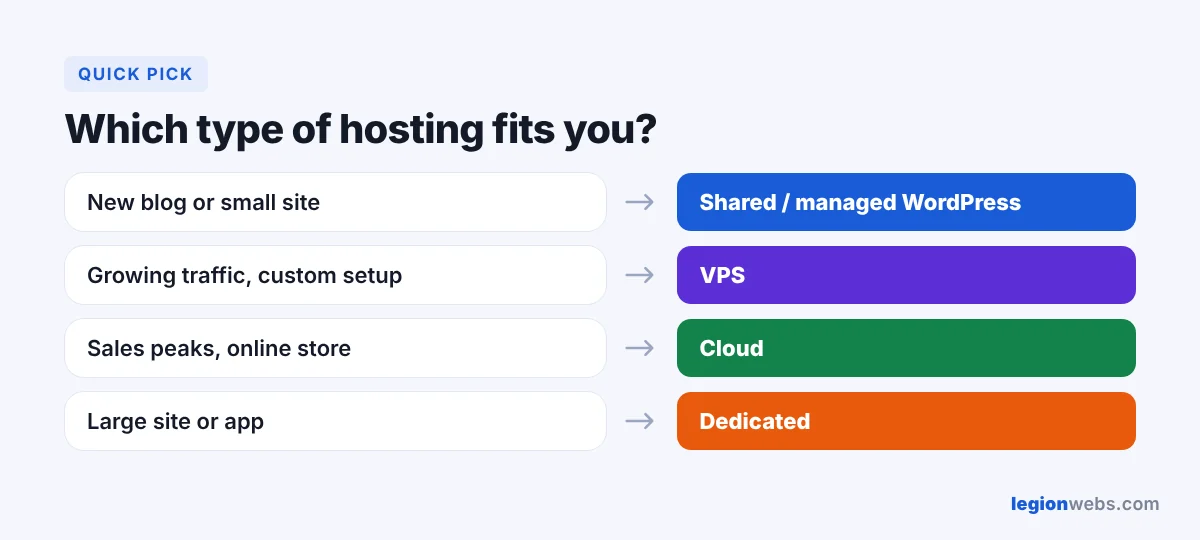
Which type of web hosting should you choose?
- Starting a blog or small site: shared or managed WordPress hosting.
- Site getting slow with more visitors: move to cloud or VPS.
- Online store with sales peaks: cloud hosting.
- Big app or many sites with special needs: VPS or dedicated.
Luckily, most hosts let you upgrade later without rebuilding your site, so there is no need to overpay on day one.
Frequently Asked Questions
Which type of web hosting is best for beginners?
Shared or managed WordPress hosting, because both are cheap, and the host handles the technical side.
Is shared hosting safe?
Yes, with a good provider. In fact, hosts isolate accounts from each other, and SSL plus regular backups protect your site further.
Can I switch hosting types later?
Yes. Within one host, for example, upgrading is usually a few clicks. Similarly, moving to another host is also possible; see How to Move Your Website to a New Host.
For a neutral overview, see Web hosting service on Wikipedia.
What’s next
Now that you know the types of web hosting, learn how to choose a web hosting provider, or start right away with a WordPress blog on Hostinger.
We recommend Hostinger for beginners: affordable plans, free SSL, one-click WordPress install and 24/7 support.
Get started with Hostinger →